
|
|
|
|
|
|
|
|
|
|
 |
|||||||
|
    |
|
With its purely instrumental compositions the Codex
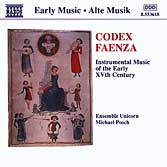
Faenza represents a special case in the period of musical creativity around 1400. The manuscript was copied between 1400 and 1420. In it an anonymous musician recorded the practice of diminution, providing tablature versions of vocal compositions. In doing so he used a musical staff of six lines, linking two of them with bar lines to create a score. In the field of vocal music at the time, it was the usual practice to write the various parts of a polyphonic composition either one after the other on the same page or in separate part books. Thus the interplay of the voices became evident only when the piece was performed in ensemble. In two separate parts the codex contains 52 ornamented versions of Italian and French secular vocal music of the 14 th century as well as liturgical cantus-firmus pieces. Among the composers represented are Guillaume de Machaut (c.1300 - 1377), Jacopo da Bologna (1340 - c.1360), Francesco Landini (c.1325 - 1397) and anonymous 14th- century composers. This mixture of cultural influences is not surprising; there was a strong French orientation in the courtly culture of Italy at the beginning of the 15th century. |
|
PRODUCER:
Michael Posch ARRANGEMENTS: Ensemble UNICORN director: Michael Posch RECORDING DATES: Evang. Kirche A.B. Wien; 28. - 30.11.1995 SOUND ENGINEERS: W*A*R Studio; Elisabeth and Wolfgang Reithofer MUSIC NOTES: Michael Posch and Riccardo Delfino |
|
||


